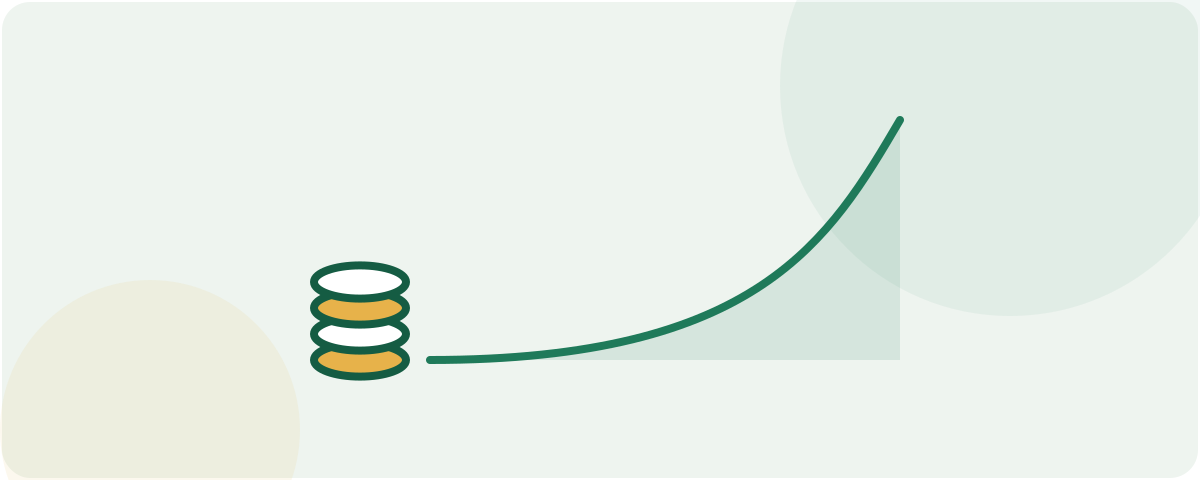
Compound interest is often called one of the most powerful forces in finance — and once you see how it works, it's easy to understand why. In plain terms, it means you earn interest not just on the money you put in, but also on the interest that money has already earned. Over time, that snowball effect can turn modest, steady saving into a surprisingly large sum, largely on its own.
The catch is that compounding rewards patience, so the sooner you understand it, the better. In this guide we'll break down the difference between simple and compound interest, walk through a clear worked example, and see why time matters even more than the amount you start with. We'll also look at how compounding can quietly work against you when you carry debt — and a few simple ways to put it firmly on your side. We'll use the dollar sign in our example, but the same maths works in any currency.
Simple interest vs compound interest
To appreciate compounding, it helps to compare it with its simpler cousin.
Simple interest is calculated only on your original amount — the principal. If you put $1,000 in an account paying 5% simple interest a year, you'd earn $50 every year, no more and no less. After three years you'd have earned $150 in total, leaving you with $1,150.
Compound interest works differently. Each period, the interest you earn is added to your balance, and the next round of interest is calculated on that new, larger balance. In other words, you start earning interest on your interest. It sounds like a small distinction, but over months and years it makes an enormous difference — and the longer it runs, the wider the gap between simple and compound interest grows.
The table below sums up the difference at a glance:
| Simple interest | Compound interest | |
|---|---|---|
| How interest is calculated | On the original principal only | On the principal plus interest already earned |
| Does past interest earn more interest? | No | Yes |
| Example: $1,000 at 5% for 3 years | $1,150.00 | about $1,157.63 |
| Where you'll usually meet it | Some fixed-term loans and simple bonds | Savings accounts, reinvested investments, and most credit-card debt |
The compound interest formula
You don't need any maths to benefit from compounding, but seeing the formula can make the idea click. The standard formula for the future value of a single lump sum earning compound interest is:
A = P(1 + r/n)nt
Here's what each letter means:
- A — the final amount, including interest.
- P — the principal, or the amount you start with.
- r — the annual interest rate written as a decimal (so 5% is 0.05).
- n — the number of times interest is compounded per year (12 for monthly, 1 for yearly).
- t — the number of years the money is left to grow.
Using our earlier example — $1,000 at 5% a year, compounded once a year, so P = 1,000, r = 0.05, n = 1 and t = 1 — the formula gives A = 1,000 × (1 + 0.05)1 = $1,050 after the first year, exactly matching the step-by-step numbers below. This version covers a single lump sum; adding regular contributions (as the calculator further down does) uses a longer form of the same idea. Treat the formula as an educational illustration: real accounts and loans can define rates, fees, and compounding differently, so always check the specific terms of any product.
A simple worked example
Let's make this concrete with a hypothetical example. Imagine you deposit $1,000 in an account that earns 5% a year, compounded once a year, and you never add another cent. Here's what happens in the first three years:
- End of year 1: your $1,000 earns $50, giving you $1,050.00.
- End of year 2: you earn 5% on $1,050 — that's $52.50 — for a total of $1,102.50. Notice you earned more this year than last; that extra $2.50 is interest on your first year's interest.
- End of year 3: 5% of $1,102.50 is about $55.13, bringing you to roughly $1,157.63.
Each year the amount of interest grows, because it's calculated on a bigger balance. That's the acceleration that makes compounding special. If we let the same $1,000 keep growing untouched, the pattern continues:
| Year | Balance at year end |
|---|---|
| 1 | $1,050.00 |
| 2 | $1,102.50 |
| 3 | $1,157.63 |
| 4 | $1,215.51 |
| 5 | $1,276.28 |
| 10 | $1,628.89 |
By year 10 your original $1,000 has grown to about $1,628 — and you didn't add a single dollar along the way. Stretch that same steady growth over 20, 30, or 40 years and the curve gets steeper still. (All figures are rounded to the nearest cent and assume a constant 5% return, which real life won't deliver — more on that shortly.)
Why time is your biggest advantage
If there's one lesson to take from compounding, it's this: time matters more than the amount you start with. Because each year's growth builds on the last, the earliest dollars you save have the longest time to multiply — so they end up doing the most work.
This is why starting early, even with small amounts, often beats starting later with larger ones. Someone who saves a little in their twenties can end up ahead of someone who saves much more but doesn't begin until their forties, simply because those early contributions had extra decades to compound.
The practical takeaway is encouraging: you don't need a big lump sum to benefit. What matters most is beginning now and staying consistent. If you're keen to get going, our guide on how to start investing with little money shows how modest, regular contributions can add up.
Quick tip
Don't wait until you can save a large amount to begin. Thanks to compounding, a small sum invested today can outgrow a bigger sum invested years from now. Starting — even modestly — is usually more important than starting big.
How often interest compounds
So far we've assumed interest is added once a year, but it can be added more often — monthly, weekly, or even daily. This is called the compounding frequency, and, generally speaking, the more often interest compounds, the faster your balance grows, because your interest starts earning its own interest sooner.
The difference between annual and monthly compounding at the same rate is usually modest, but it's real, and it adds up over long periods. This is also why you'll sometimes see two figures quoted for the same account: a basic interest rate and an effective annual rate that reflects the compounding. When you're comparing options, the effective annual figure gives you a fairer like-for-like comparison.
Annual vs monthly compounding: a quick example
Let's put numbers on that difference using the same hypothetical $1,000 at a 5% annual rate, left untouched for one year — the only thing we change is how often the interest is added.
- Compounded once a year: you earn a flat 5%, so you finish the year with $1,050.00.
- Compounded monthly: you earn about 0.4167% each month (that's 5% ÷ 12) on a balance that grows a little every month. After twelve months that works out to roughly $1,051.16.
The gap here is just over a dollar in the first year — small, as promised. But that slightly higher effective rate (about 5.12% rather than 5%) keeps applying year after year, so over long stretches the difference becomes more noticeable. Note this example assumes a single, constant 5% rate that never changes, which no real account will deliver; it's here to show the mechanics, not to predict what any specific account will pay.
Try it yourself: a compound-interest calculator
Use this simple calculator to see how compounding might play out with different amounts, rates, and time frames. Enter your own numbers and it will estimate how a balance could grow, assuming a steady rate and a regular contribution added at the end of each compounding period. The starting figures below use the $1,000 example from this guide.
Compound-interest estimator
These figures are estimates for illustration only. The calculator assumes a single, constant rate and a contribution added at the end of every compounding period, and it ignores fees, taxes, and inflation. Real savings rates and investment returns change over time and are not guaranteed, so your actual results will differ. This tool is educational and is not investment advice or a recommendation to buy any product.
Want a version you can bookmark or share, with contributions and growth shown separately? See the full-page compound interest calculator.
A quick reality check
It's important to be clear about one thing: our tidy 5% example is an illustration, not a promise. Real-world returns are not guaranteed. Savings rates rise and fall, and investment returns vary from year to year — some years are up, some are down, and no one can reliably predict them in advance. Investing always carries risk, including the risk of losing money.
So don't expect a smooth, straight-line 5% every year in real life. We used a fixed rate purely to show the mechanics of compounding clearly. The core idea — that reinvested earnings can grow on themselves over time — holds true, but the actual numbers you experience will bounce around. This article is general educational information, not personalized or investment advice; if you'd like guidance for your own situation, consider speaking with a qualified professional.
What compound interest does — and doesn't — mean
Compounding is powerful, but it's easy to over-read what it promises. Here's a balanced view of both sides.
What it can do
- Help savings and investments grow faster over time, as earnings start earning too.
- Reward starting early and contributing consistently, even with small amounts.
- Turn steady, unglamorous habits into meaningful sums over many years.
What it doesn't mean
- It is not a guaranteed return — investment values rise and fall, and you can lose money.
- Savings-account rates can change, so a rate you see today may not last.
- Inflation can reduce what your money actually buys, even as the balance grows.
- Fees and taxes can quietly eat into real-world results.
- It cuts both ways: debt can compound against you just as savings compound for you.
When compounding works against you
Here's the flip side that catches many people out: compounding doesn't only build wealth — it can also deepen debt. When you carry a balance on a high-interest debt like a credit card, interest is charged on what you owe, and if it goes unpaid it gets added to your balance. The next round of interest is then charged on that larger amount. It's the same snowball, only rolling in the wrong direction.
That's why high-interest debt can feel so hard to escape: the balance grows on itself, just as savings do. The good news is that the reverse is also true — every extra payment you make shrinks the balance that future interest is calculated on. If you're wrestling with card balances, our guide on how to get out of credit-card debt can help you turn that snowball around. As a rule of thumb, paying down expensive debt is one of the most reliable "returns" you can get.
Simple ways to put compounding to work
You don't need to be a finance expert to make compounding your ally. A few straightforward habits do most of the heavy lifting:
- Start now. The earlier you begin, the more time your money has to grow. Today beats next year.
- Stay consistent. Regular contributions, however small, keep feeding the snowball. Automating them makes it effortless.
- Reinvest what you earn. Leaving interest, dividends, or returns to compound — rather than spending them — is what powers the whole effect.
- Be patient. Compounding starts slowly and speeds up later. The most dramatic growth tends to come in the final years, so give it time.
It's also wise to build a financial cushion before you tie money up for the long term. A starter emergency fund keeps a surprise expense from forcing you to raid your savings at the worst possible moment, letting your long-term money stay put and keep compounding.
Common mistakes people make with compounding
A few avoidable slip-ups can blunt the effect of compounding. Watch out for these:
- Waiting for the "perfect" moment. Delaying until you can save a big amount usually costs more than starting small today, because you give up your most valuable ingredient: time.
- Interrupting the snowball. Dipping into long-term savings for non-emergencies resets some of the compounding you've built. A separate emergency fund helps protect it.
- Ignoring high-interest debt. Chasing savings growth while carrying expensive debt often means the debt compounds faster than your savings. A clear debt-payoff plan usually comes first.
- Assuming a fixed rate is guaranteed. Illustrations use a steady rate for clarity; real returns bounce around, so plan with realistic, flexible expectations.
- Forgetting fees, taxes, and inflation. These quietly reduce real-world results, so the headline number is rarely the whole story.
Your compound-interest checklist
Put compounding on your side
- Start now, even with a small amount.
- Set up an automatic, regular contribution.
- Build saving into your monthly budget so it happens on purpose.
- Reinvest interest, dividends, and returns rather than spending them.
- Keep a separate emergency fund so you don't have to raid long-term savings.
- Tackle high-interest debt, which compounds against you.
- Compare accounts using the effective annual rate, not just the headline rate.
- Be patient — the biggest growth tends to come in the later years.
The bottom line
Compound interest is simply interest earning interest — but given enough time, that simple idea becomes a powerful engine for building wealth. The two things that matter most are starting early and staying consistent; the exact amount you begin with matters far less than the years you give it.
Just remember the illustration cuts both ways. Put compounding to work through steady saving and investing, and keep it from working against you by tackling high-interest debt. Do both, and you'll have one of finance's most powerful forces firmly on your side. The best day to start was years ago — the second-best day is today.
Frequently asked questions
What is compound interest?
Compound interest is interest calculated on both your original amount (the principal) and the interest it has already earned. Because each period's interest is added to the balance, future interest is worked out on a larger and larger sum, so your money can grow at an accelerating pace over time.
Is compound interest the same as APR?
No. APR, or annual percentage rate, is a standardised figure that describes the yearly cost of borrowing, sometimes including certain fees. Compound interest describes how interest is calculated and added over time. For savings you may also see APY, or annual percentage yield, an effective annual rate that already reflects compounding. When comparing accounts, the effective annual figure gives a fairer like-for-like comparison than a basic rate alone.
Is monthly compounding better than annual compounding?
At the same stated rate, more frequent compounding produces slightly more growth, because interest starts earning its own interest sooner. The difference is usually small over short periods but can add up over many years. When comparing real accounts, look at the effective annual rate, which already accounts for how often interest compounds.
Can compound interest work against you?
Yes. The same mechanism that grows savings can deepen debt. On borrowing such as credit cards, unpaid interest can be added to your balance, and future interest is then charged on that larger amount. That is why high-interest debt can grow quickly, and why paying it down is often one of the most reliable financial moves you can make.
How long does compound interest take to make a difference?
Compounding starts slowly and speeds up. Over a year or two the effect is modest, but over decades it can become dramatic, because the largest growth tends to come in the later years. The practical lesson is that starting early and staying consistent usually matters more than the amount you begin with.
Can I benefit from compounding with a small amount of money?
Yes. Compounding works on any amount, and time matters more than size. Small, regular contributions can grow meaningfully given enough time, which is why beginning now, even modestly, is generally more valuable than waiting until you can save a large sum.
Sources & further reading
Compound interest is a standard, widely documented idea, and the wording and examples in this guide are our own. To double-check the concepts and give you trustworthy places to read more, we relied on official government and regulatory resources. If you'd like to dig deeper or confirm the rules for your own country, these are good starting points:
- U.S. Securities and Exchange Commission (Investor.gov) Compound interest calculator and investor education
- Consumer Financial Protection Bureau (CFPB) Consumer guidance on saving, borrowing, and credit
- Federal Reserve How U.S. interest-rate policy works
- Federal Deposit Insurance Corporation (FDIC) How deposit insurance protects your savings
- Internal Revenue Service (IRS) How interest and investment income is taxed
- GOV.UK UK government guidance on savings and money
- Financial Conduct Authority (FCA) The UK's financial regulator
- Bank of England UK interest rates and inflation explained
- MoneyHelper (UK, government-backed) Free, impartial money guidance