Budgeting has a reputation for being complicated, but it really doesn't have to be. If spreadsheets with forty categories make your eyes glaze over, the 50/30/20 rule might be the fresh start you're looking for. It splits your income into just three simple buckets — and honestly, that's the whole system.
In this guide you'll learn exactly how the rule works, see it applied to a real take-home pay of $3,000 a month, and find out when it makes sense to bend the percentages to fit your own life. It's one of the friendliest ways to take control of your money without tracking every last cup of coffee.
What is the 50/30/20 rule?
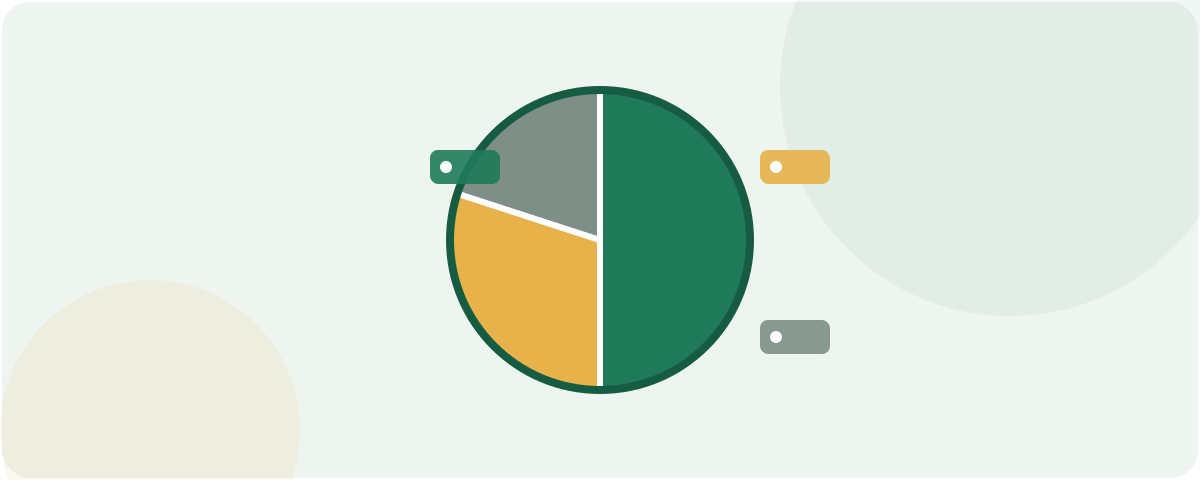
The 50/30/20 rule is a simple way to divide your after-tax income — the money that actually lands in your account — into three groups:
- 50% for needs — the things you have to pay for.
- 30% for wants — the things that make life enjoyable.
- 20% for savings and debt — building your future and clearing what you owe.
The beauty is that you only have to remember three numbers. Instead of agonising over dozens of line items, you simply check whether your spending roughly fits these proportions. It became popular as a plain-English framework for people who wanted a budget they would actually stick to.
One quick definition: after-tax income (also called take-home pay or net pay) is what's left once tax and any automatic deductions have come out. If you're self-employed, set aside your tax first, then apply the rule to whatever remains. Getting this figure right is the foundation of the whole rule, so it's worth checking a recent payslip before you start.
The 50%: needs
Needs are the non-negotiables — the costs you'd genuinely struggle to live without. Aim to keep them at around half of your take-home pay. Typical needs include:
- Rent or mortgage payments
- Utilities like electricity, water, and heating
- Basic groceries
- Getting to work — fuel, insurance, or a transit pass
- Minimum payments on any debts
- Essential insurance and childcare
Here's where people trip up: a need is what keeps a roof over your head and gets you to work — not the premium version of everything. A basic phone plan is a need; the newest handset on a pricey contract edges into "want" territory. If your needs are eating well over half your income, treat that as a signal rather than a failure — and the fix usually lies in your biggest bills, not the small stuff. Trimming one big fixed cost beats cutting tiny treats every day.
The 30%: wants
Wants are the things you choose because they make life more fun and comfortable. They're not wasteful — they're what makes a budget liveable. This bucket covers:
- Eating out, takeaways, and coffee runs
- Streaming services and subscriptions
- Hobbies, gym memberships, and days out
- Holidays and travel
- Upgrades — the nicer car, the bigger TV, brand-name clothes
Giving yourself a guilt-free 30% is the secret to why this rule sticks. Plenty of budgets fail because they're too strict, and then one tough week tips you off the wagon entirely. By planning for enjoyment, you're far less likely to rebel against your own plan. When you want to grow your savings faster, this is the most flexible bucket to trim — our list of ways to save money is full of painless swaps.
The 20%: savings and debt
The final fifth is the part that quietly changes your life. It goes toward:
- Building an emergency fund — a cash cushion for surprises
- Paying off debt beyond the minimums, such as credit cards and loans
- Saving for goals like a home deposit or a car
- Long-term investing and retirement contributions
If you're carrying high-interest debt, point this bucket there first, once you have a small starter emergency fund in place. Clearing expensive debt is one of the most reliable ways to get ahead: the interest you stop paying is money that stays in your pocket. When the debt is gone, redirect that same 20% straight into savings and investing — you're already used to living without it. That switch, from clearing debt to building wealth, is one of the most satisfying moments in any money journey.
Rule of thumb
Pay this 20% first, not last. Move it to savings or debt the day you're paid, before it has a chance to disappear. What you don't see, you tend not to miss — and "paying yourself first" is the habit that does most of the heavy lifting.
A worked example with real numbers
Say your take-home pay is $3,000 a month. Here's how the 50/30/20 rule would split it:
| Category | Share | Monthly amount |
|---|---|---|
| Needs | 50% | $1,500 |
| Wants | 30% | $900 |
| Savings & debt | 20% | $600 |
These numbers are illustrative — your income and costs will differ, and amounts vary by country and currency.
So you'd aim to keep rent, groceries, and other essentials under $1,500, enjoy up to $900 on the fun stuff, and send $600 toward savings and debt every month. Over a year, that 20% adds up to $7,200 working in your favour — before any interest or employer top-ups. Don't panic if your first month doesn't land on these figures; almost nobody's does. The point is to see where you are now and nudge closer over time. If you've never mapped your spending, our guide on how to make a budget walks you through it step by step.
50/30/20 budget calculator
Prefer to see it with your own numbers? Enter your monthly take-home pay below and the calculator splits it into the three buckets instantly. It runs entirely in your browser — nothing you type is saved or sent anywhere.
Work out your split
Illustrative budgeting estimate — not financial advice. Read the “$” as your own currency; the percentages work the same everywhere. The 50/30/20 split is a starting point, not a target you must hit exactly — if your needs come to more than 50%, that is common, and the notes below explain how to adapt it.
Want a version you can bookmark or share, with a worked example and the method spelled out? See the full-page 50/30/20 budget calculator.
When to adjust the percentages
The 50/30/20 split is a starting point, not a straitjacket. Real life varies hugely depending on where you live and what you earn.
Common tweaks
- High cost of living: in expensive cities, rent alone can swallow half your pay. A 60/20/20 or even 70/20/10 split may be more honest while you get established.
- Lower income: when money is tight, needs naturally take a bigger share. Protect even a small savings slice — 5% is far better than 0%.
- Higher income or big goals: if you're comfortable, flip the script. Many people chasing early debt payoff or a house deposit run something like 50/20/30, funnelling more into that final bucket.
Currency and country matter too. Whether you earn dollars, pounds, or something else, the percentages stay the same — only the amounts change. Use the ratios as a compass, not a cage. The goal isn't to hit the numbers perfectly on day one; it's to have a target worth aiming at.
Putting the rule into practice
The maths is the easy part. These are the questions that tend to come up once you actually try to live by the split.
How to work out your take-home pay
Start from the money that actually reaches your account, not your headline salary. Look at a recent payslip and use the net figure — what is left after tax and any automatic deductions. If your pay varies, take an average of the last three months. If you are self-employed, set aside money for tax first and treat what remains as your take-home pay, so the rule is built on money you can genuinely spend.
Sorting the borderline expenses
Some costs sit awkwardly between a need and a want, and that is normal. A useful test is to ask what the basic version costs: a simple phone plan is a need, while the premium handset and unlimited data edge into wants. The same goes for food — everyday groceries are a need, regular takeaways are a want. You do not have to get every line perfect; aim for roughly right and stay consistent from month to month.
What to do if your needs are over 50%
For many people, especially in expensive areas, essentials take more than half of take-home pay. Treat that as information, not a personal failing. Look first at your largest fixed costs — housing, transport, and insurance — because shaving one big bill usually frees up more than trimming small treats. In the meantime, adjust the split to something honest and protect even a small savings slice rather than dropping it to zero.
Using it with an irregular income
If your income changes from month to month, base the percentages on a low or average month rather than your best one. Another approach is to run the split on each payment as it arrives, moving the savings-and-debt share aside straight away. Building a small buffer during the good months smooths out the lean ones — which is exactly what an emergency fund is for.
The pros and cons
Like any tool, this one comes with trade-offs.
The pros
- Dead simple — three numbers, no spreadsheet required.
- Flexible — the 30% keeps it sustainable.
- A great on-ramp for total beginners.
- Works with any income or currency.
The cons
- Too broad for some — if you're deep in debt, you may need a tighter plan.
- The needs-versus-wants line can get blurry.
- 20% may not be enough to reach big goals quickly.
- It tells you to save the 20%, but not how to invest it.
For most people starting out, the simplicity outweighs the drawbacks. You can always graduate to a more detailed system later — and pairing the rule with a few practical ways to save money helps each bucket stretch further.
The bottom line
The 50/30/20 rule works because it's easy to remember and easy to live with. Half for needs, a third for wants, a fifth for your future — that's the whole idea. It won't be a perfect fit for everyone, and that's fine; treat the percentages as a friendly guide and adjust them to your reality.
The best budget is the one you'll actually keep. If a simpler system helps you finally move money toward savings and debt each month, it's doing its job. Start where you are, aim for the ratios over time, and let those small, steady steps add up. When you're ready for the next stage, learning how to make a budget in detail — and building an emergency fund to fall back on — are natural places to head next.
Frequently asked questions
Is the 50/30/20 rule realistic?
For many people it is a realistic starting point, but it is not a perfect fit for everyone. If you live somewhere with high housing costs, or you are on a low income, your needs can easily take more than 50 percent, which leaves less for the other two buckets. The rule is best treated as a target to move toward over time rather than a test you pass or fail in your first month.
What if my needs are more than 50 percent?
This is very common, especially where rent or housing is expensive. Do not treat it as a failure. First look at your largest fixed costs, since trimming one big bill usually helps more than cutting many small treats. If your needs are still above 50 percent, adjust the split to something more honest, such as 60/20/20 or 70/20/10, and protect even a small savings amount while you work on raising income or lowering costs.
Does debt repayment count toward the 20 percent?
Minimum debt payments are treated as needs and sit in the 50 percent bucket, because you have to make them. Any extra payments you make to clear debt faster count toward the 20 percent savings-and-debt bucket. In practice, many people starting out send most of that 20 percent to high-interest debt first, then switch it to saving and investing once the expensive debt is gone.
Can I use 50/30/20 on a low income?
Yes, though the percentages often need adjusting. When money is tight, needs naturally take a larger share, so the standard split may not fit at first. The habit that matters most is saving something, even if it is only a small percentage, and building from there. A priority-based approach, where you fund essentials first and then save what you can, often works better than forcing the exact ratios.
Does investing count toward the 20 percent?
Yes. The 20 percent bucket covers saving, investing, and extra debt repayment. That includes building an emergency fund, adding to long-term or retirement investments, and paying down debt beyond the minimums. The rule tells you how much to set aside, but not which specific accounts or investments to choose, so how you divide that 20 percent is up to you and your goals.
Can I change the percentages?
Absolutely. The percentages are a guide, not a rule you must obey. Plenty of people use variations such as 50/20/30 to save more aggressively, or 60/20/20 when housing is expensive. The three-bucket idea is what makes the system easy to stick with, so keep the structure and adjust the numbers to match your income, your costs, and your goals.
Sources & further reading
The explanations and examples in this guide are our own. To keep them accurate, and to give you trustworthy places to read more, we drew on official government and regulatory resources. These are good, impartial starting points if you want to confirm the details for your own country:
- Consumer Financial Protection Bureau (CFPB) Consumer guidance on budgeting, saving, borrowing, and credit
- MoneyHelper (UK, government-backed) Free, impartial money guidance